
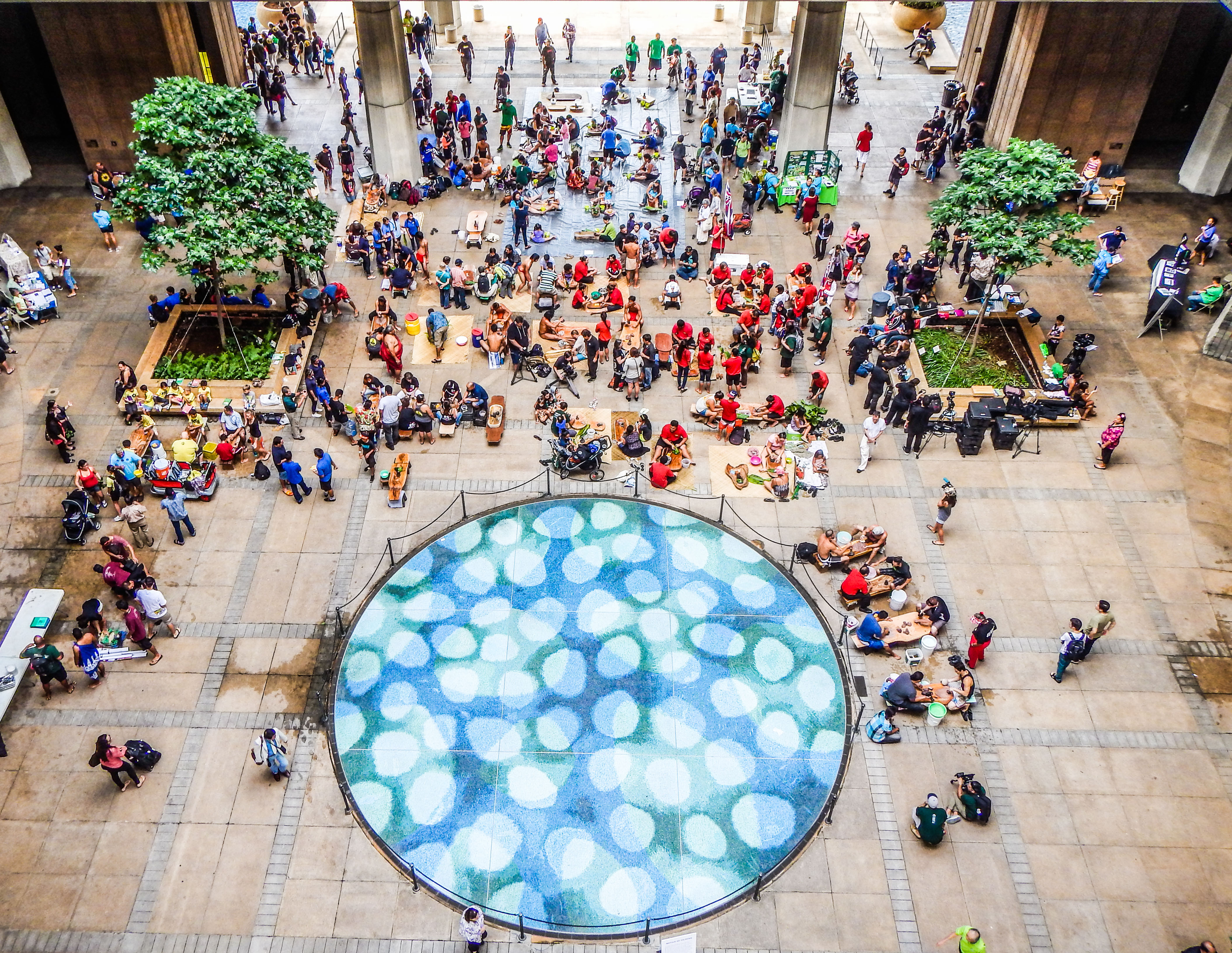
HB644 would prohibit single-use plastics statewide, creating a consistent standard across counties and addressing one of the most persistent sources of marine debris in our islands.
Single-use plastics are among the most commonly collected items at coastal cleanups. A statewide approach would reduce plastic pollution at the source, support the transition to reusable systems, and move Hawaiʻi closer to a circular economy.
HB644 TESTIMONY TEMPLATE AT THE END OF THIS BLOG
SB2213 establishes an environmentally friendly schools initiative within the Hawaiʻi Department of Education, integrating sustainability into school curricula, reducing campus waste, phasing out single-use plastics, and expanding water bottle filling stations.
With more than 165,000 students enrolled in public and charter schools statewide, this bill represents long-term systems change — embedding mālama ʻāina and climate literacy into everyday learning environments.
SB2213 TESTIMONY TEMPLATE AT THE END OF THIS BLOG
HB2281 would authorize the Hawaiʻi Department of Land and Natural Resources (DLNR) to enter into formal co-management agreements with qualified Hawaiʻi-based nonprofits.
Community organizations are already stewarding coastlines, fishponds, and forests across the pae ʻāina. This bill strengthens collaboration between government and community, empowering local expertise and shared responsibility in natural resource management.
HB2281 TESTIMONY TEMPLATE AT THE END OF THIS BLOG
In addition to our priority measures, SCH is also supporting several complementary bills that align with our mission and values:
While these may not be our primary focus bills this session, they represent important steps toward environmental health, accountability, and resilience statewide. We encourage our community to support them as well.
Public testimony is a powerful tool in shaping policy. When these bills are scheduled for hearings, we encourage you to submit written testimony or show up in support.
To make it easier, we are providing sample testimony templates for our three priority bills that you can personalize with your own story. Please click on the templates below.
Be sure to follow SCH on social media, where we will post calls to action and hearing alerts for all of these bills throughout the session.
Real change happens when everyday people engage in the civic process. By submitting testimony, attending hearings, and making our voices heard, we hold decision-makers accountable and help shape the policies that protect our coastlines and our communities. Together, through active participation in the legislative process, we can create a more regenerative, resilient, and sustainable future.
Full Name / Organization or Affiliation (if applicable) / Your Email Address
Measure
HB644
Your Position
Support
[Feel free to introduce yourself and share a personal story — maybe a beach cleanup you participated in, something you’ve noticed about plastic waste in your neighborhood, or efforts you’ve made to reduce single-use plastics in your own life. Personal experiences make your testimony more powerful.]
Aloha,
My name is ________ and I strongly support HB644 to prohibit the use, sale, and distribution of disposable or single-use plastic foodware and foodware containing perfluoroalkyl and polyfluoroalkyl substances (PFAS) by businesses in Hawaiʻi.
Single-use plastics and disposable foodware are among the most common items found in our waste stream and coastal environments. These materials persist in our ecosystems, harm wildlife, and contribute to microplastic pollution that ultimately impacts our health, our ocean, and our communities. Reducing unnecessary plastic at the source is one of the most effective ways to prevent this pollution before it reaches our beaches and nearshore waters.
This bill is also an important step toward advancing Hawaiʻi’s sustainability and waste reduction goals. By addressing disposable foodware and harmful chemical additives like PFAS, HB644 helps move our state toward safer, healthier alternatives and a more responsible materials economy.
Please pass HB644 and continue strengthening Hawaiʻi’s leadership in protecting our environment for future generations.
Mahalo for your time and consideration.
Full Name / Organization or Affiliation (if applicable) / Your Email Address
Measure
SB2213
Your Position
Support
[Feel free to introduce yourself and provide your personal story – maybe it's a cleanup you did with SCH, an experience you had with your own waste reduction efforts, implementation of sustainable practices, or your experiences with Hawai‘i’s public and charter schools that inspired you…the more you personalize this, the stronger the testimony becomes.]
Aloha,
My name is ________ and I strongly support SB2213 to establish an environmentally friendly schools initiative within the department of education. This initiative would integrate environmental stewardship into school curricula, establish sustainability programs, phase out single-use plastics, and increase availability of water bottle filling stations on public school campuses.
Honolulu generates an estimated 1.7 million tons of waste annually, much of which still ends up in landfills or incineration despite sustainability goals, single-use plastic reduction laws, food waste recycling intentions, and the City’s stated goal to reduce waste by 25% by 2030 from 6.5 pounds per day to 4.9 pounds per day. Current systems rely heavily on exporting recyclables and importing food (much of which is wrapped in single-use plastic). Furthermore, according to the City and County of Honolulu, the total food waste in Hawai‘i is estimated at over $1 billion per year, which was equivalent to 1.52 times the total production of agriculture in Hawai‘i in 2010. Without prioritizing reduction and reuse on a large scale, as well as composting of food waste, Honolulu risks falling behind state and global sustainability standards.
Establishing an environmentally friendly schools initiative would help institutionalize and normalize waste reduction and sustainable practices in the state by implementing and educating students on sustainability and mālama ʻāina statewide. With a total of 165,340 students enrolled in Hawai‘i’s public and charter schools as of the 2024-25 school year, this initiative would significantly assist in reaching Hawaiʻi’s waste reduction and energy conservation goals, while also cultivating environmental responsibility for Hawaiʻi’s next generation.
Please advance bill SB2213 to make Honolulu public schools a leader in circular economy and sustainability education.
Mahalo for your time and consideration.
Full Name / Organization or Affiliation (if applicable) / Your Email Address
Measure
HB2218
Your Position
Support
[Feel free to introduce yourself and share a personal story — perhaps your experience volunteering in conservation, participating in a cleanup, caring for a shoreline, working in loʻi, fishing, or engaging in cultural practices. Personal connection to ʻāina makes testimony stronger.]
Aloha,
My name is ________ and I strongly support HB2218 to authorize community co-management agreements between the State of Hawaiʻi Department of Land and Natural Resources (DLNR) and qualified Hawaiʻi-based nonprofit organizations.
Hawaiʻi’s communities have deep knowledge of and connection to their ʻāina. Across the islands, local residents, cultural practitioners, and nonprofit organizations are already actively caring for coastlines, forests, streams, and other public lands. This bill provides a structured and transparent pathway for DLNR to formally partner with community groups in ways that strengthen stewardship, accountability, and long-term sustainability.
Community co-management does not replace the important work of DLNR. Instead, it expands capacity by equipping communities with the tools to support mālama ʻāina efforts in regions that often lack sufficient state resources. Formalizing these partnerships will help ensure that conservation efforts are place-based, culturally informed, and responsive to local needs.
There are already successful examples across Hawaiʻi of collaborative stewardship models — from community-based subsistence fishing areas to adopt-a-park programs — that demonstrate how empowering communities leads to stronger environmental outcomes. HB2218 builds on these successes and creates a clear framework to expand them statewide.
Please pass HB2218 and continue supporting policies that strengthen community stewardship of our public trust lands.
Mahalo for your time and consideration.


.svg)